Sameification

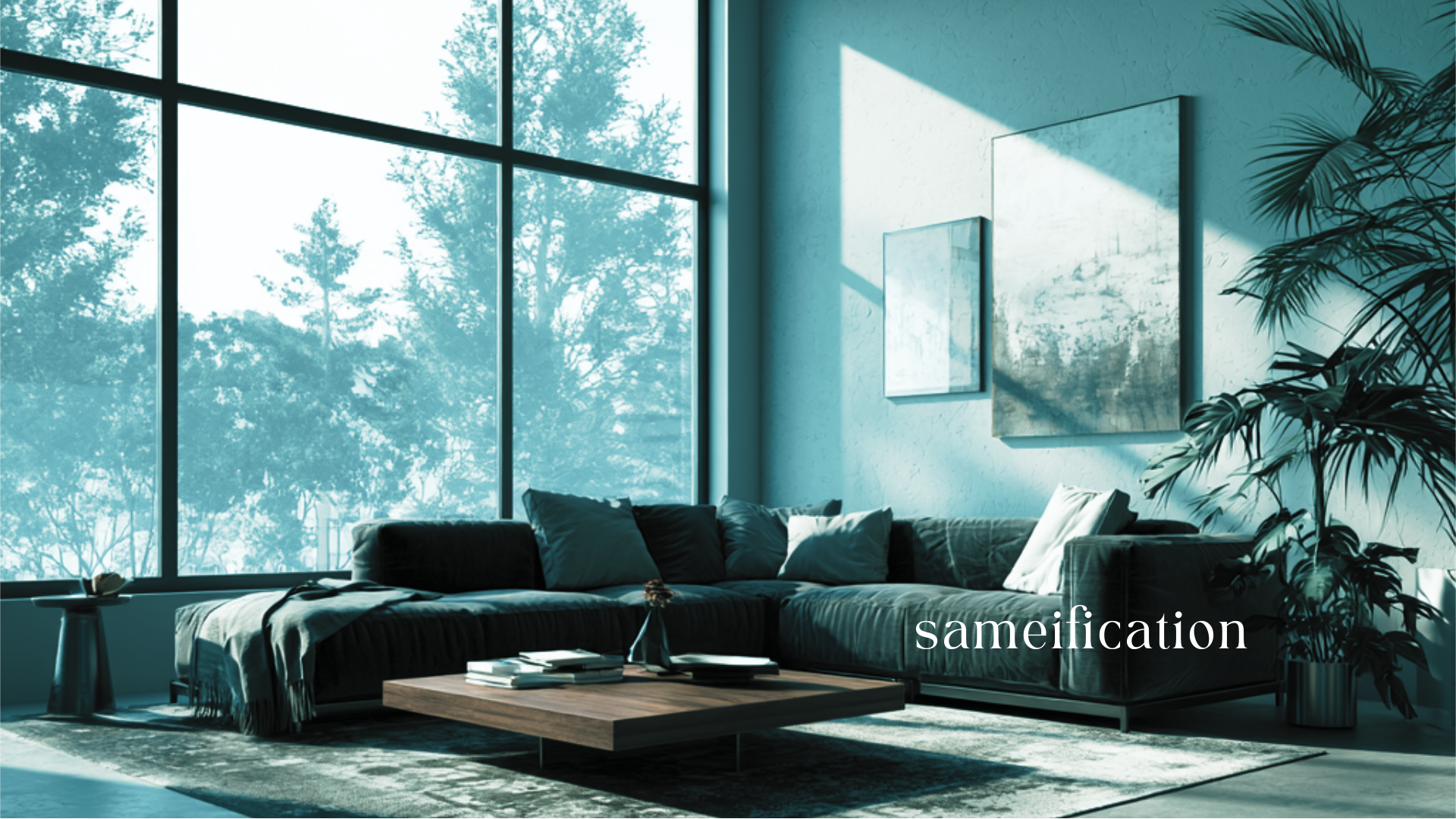
Somewhere between the promise of digital transformation and the reality of usage, something went wrong. At first, it was invisible, but you could feel that the quality of everything improved a little. It happened subtlety, until one day you lost hours to doomscrolling, read a LinkedIn post that didn’t say anything, or walked into a coffee shop you had never visited and felt that you had been there before.
What started as the democratization of style turned into a flattening of taste. It has been accelerating in three distinct waves, the latest carries the biggest risk.
In 2025, researchers at the London Business School wrote a paper about the impact of LLMs on expression.[1] When ChatGPT was temporarily banned in Milan, the city's restaurants kept posting on social media. The researchers found that without ChatGPT, the content became 15 percent more different words and 12 percent more varied syntax. When they could use ChatGPT again, and the sameness returned. The study was framed as research into AI adoption but is also measured was the rate at which voice disappears.
At first we thought it was good for us...
The sameification began innocently, with the growth of access to the Internet and social media.
Digitalization handed every potential entrepreneur the same toolkit: the same Squarespace and WordPress templates, the same Canva color palettes, the same Shopify storefronts optimized for the same conversion metrics. The logic was dopamine and money. What it produced, at scale, was a visual monoculture. By the mid-2010s, you could walk into any yoga studio from Stockholm to Ho Chi Minh City and read the same sans-serif affirmations, smell the same palo santo, and receive the same Instagram grid with neutral tones. The international aesthetic, as I referred to it then, felt familiar and comfortable.
In the first wave samefication, it simplified choice by reducing friction and signaling quality.
Then sameification became the default.
The pandemic compressed what might have taken a decade into eighteen months.
When physical space closed, digital presence became everything. The brand became the website, social media and YouTube impressions. The restaurant became the Instagram account. The consultant became the LinkedIn presence. And all of those ways of showing up were running on the same infrastructure, optimized by the same algorithms.
The pandemic made sameification inescapable. The clean designs created a smooth, frictionless digital oasis in a sea of physical fear and panic. The rise of monoculture established itself at a speed no one anticipated because everyone was trapped inside. One of the few places in the world that allowed in-person interaction was Sweden, which is already a monoculture, but I will save that for another time.
By 2022, the signals were measurable. According to 1stDibs' annual survey of 880 interior designers, the share of customized pieces in design projects had fallen from 58 percent in 2018 to 47 percent—a quiet and firm indication that blandness and normcore were comfortable even if they weren’t cool. [2] You could land in a city you had never visited and know, before leaving the airport, exactly what the good neighborhood would look and feel like. This was before anyone had heard of ChatGPT.
In the second wave of sameification, we got comfortable and slightly trapped.
How will this impact us?
Now we are in the third acceleration.
This is the moment when we have gotten comfortable with the algorithms. It is easier to accept the default than to do something different. It is easier to select from a menu of choices than to decide what exactly you want.
If you listen to how people speak, they say “I should”, “I must”, or “I need” much more often than “I want” or “I will.” Sameification has hacked into our nervous systems and made us compliant, unimaginative and afraid of standing out. It requires little effort and produces output that is totally okay. When the default becomes the reflex, the nervous system stops asking the question. At scale, that is not a content problem. That is an evolutionary one.
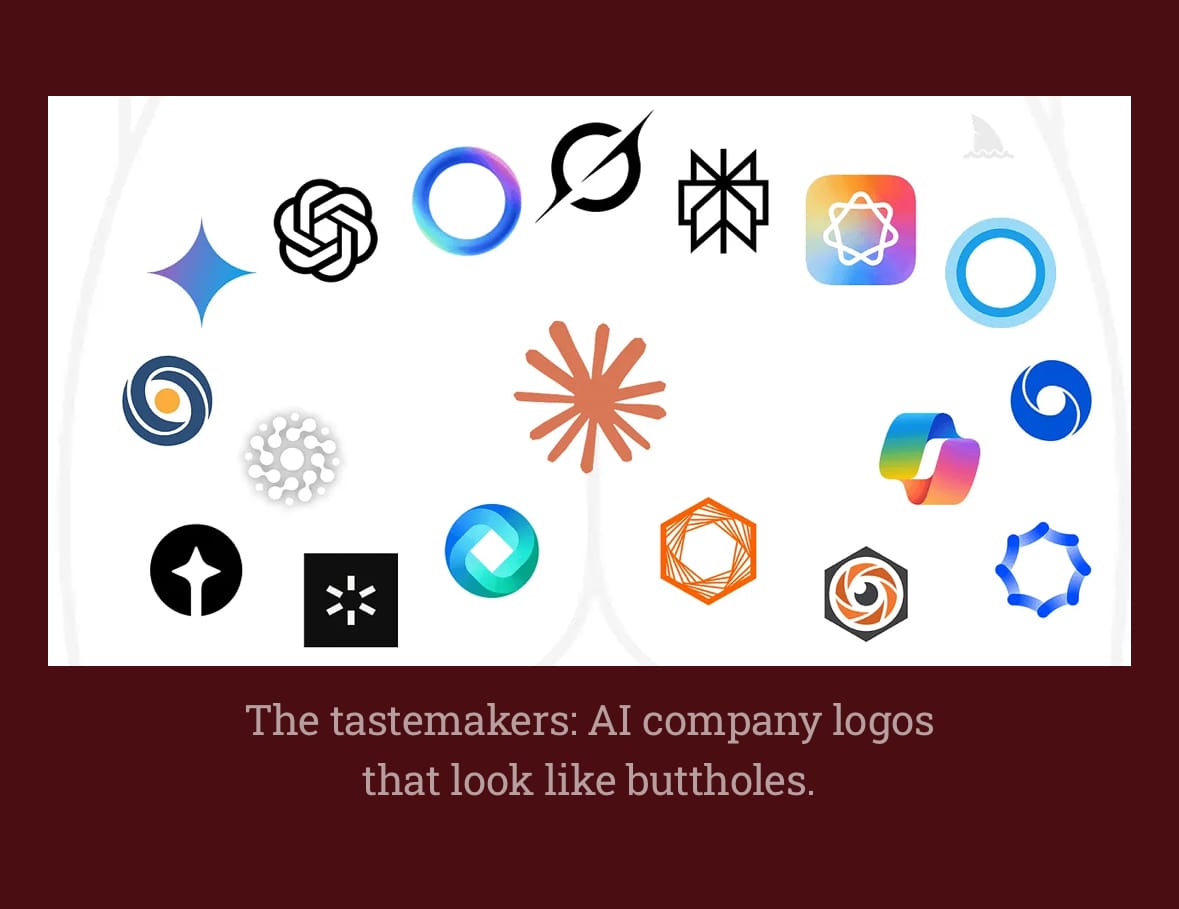
The proof is not only in Milan. Look at the logos. Reader, they all look like butt holes and no one cares!
The antidote is simpler than it you may think. Put yourself somewhere the algorithm can’t control. A trail. A kitchen. A conversation with someone who will push back. Sameification cannot survive in a fully inhabited life. Your nervous system knows the difference. Pay attention.
references
[1] Liu, Chaoran and Wang, Tong and Yang, S. Alex, Generative AI and Content Homogenization: The Case of Digital Marketing (July 26, 2025). Available at SSRN: https://ssrn.com/abstract=5367123
[2] 1stDibs: https://www.1stdibs.com/blogs/the-study/interior-design-trends-2023/